Sora free: why it shut down and what to use instead

Sora is gone. OpenAI switched off the Sora web experience and app on April 26, 2026, and the Sora API shuts down on September 24, 2026. So searching for "Sora free" no longer leads anywhere: there is no free Sora and there won't be, and anything you made there should be exported before the data is deleted. The job itself, though, is still doable — on NeuralSpace you turn a text description into a short video in the Video section with no subscription, paying in tokens for the generations you actually run, and new users receive starter tokens. Below: what exactly happened to Sora, which models replace it, and how to run your first clip.
What happened to Sora
OpenAI launched Sora 2 in late September 2025 — first as an invite-only iOS app in the US and Canada, then as the sora.com web experience. Generations were initially free with generous limits, and the higher-quality Sora 2 Pro mode was available to ChatGPT Pro subscribers. Then, on April 26, 2026, the Sora app and web experience were shut down, and on September 24, 2026 the API follows. OpenAI recommends exporting what you created via sora.chatgpt.com/sunset; once the export window closes the data is deleted, and any purchased credits can only be used for Codex.
For the user this means one thing: there is no free Sora left to find. Invites won't help, and the service that once handed out a few clips a day has officially ended.
What replaces Sora: the Video section on NeuralSpace
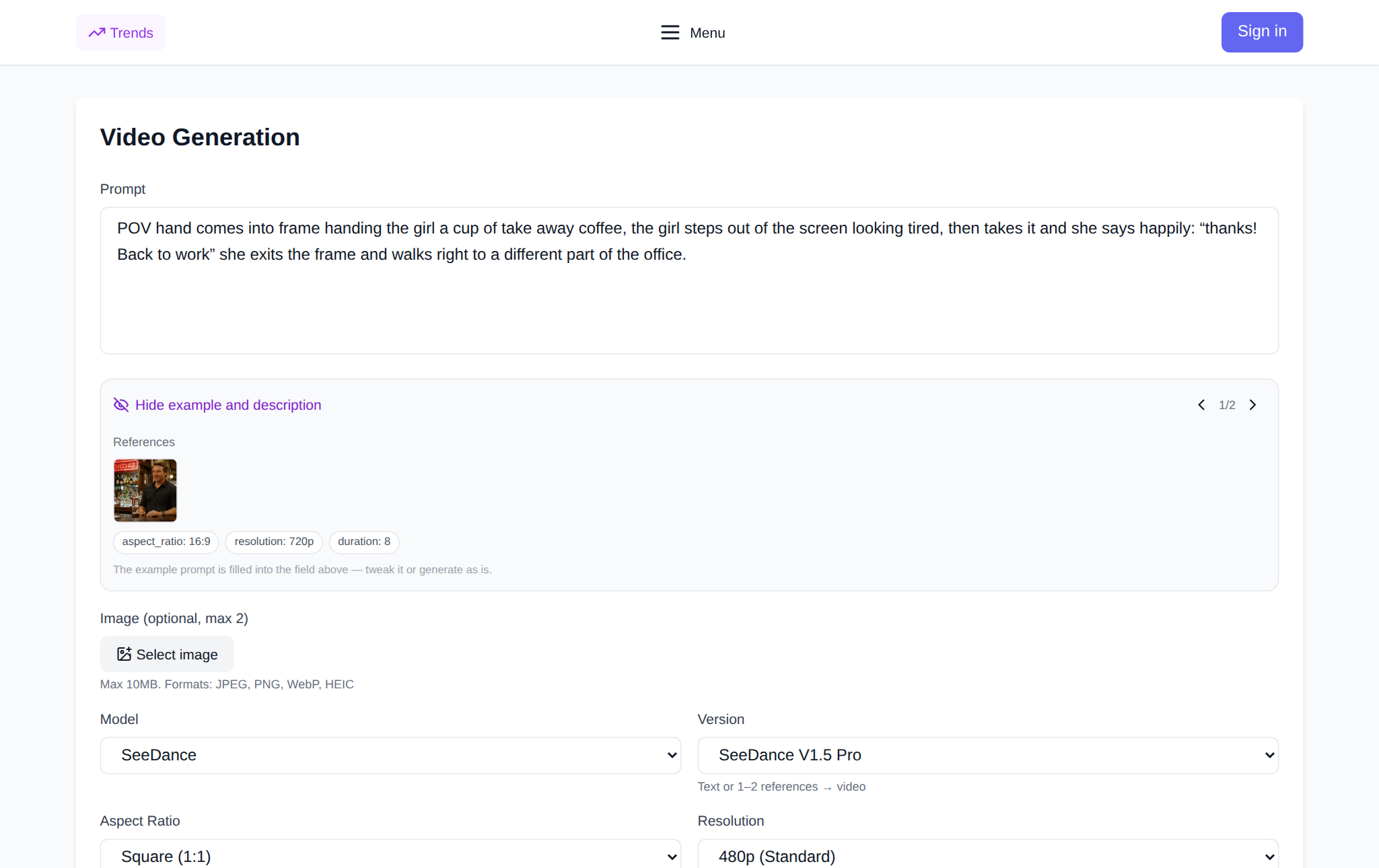
Text-to-video generation lives in the Video section. There is no subscription: generations are charged in tokens, the price is shown before you run, and a single balance covers every tool on the site. The catalog is broader than Sora's was and covers the same scenarios:
- SeeDance 2.5 — a general text-to-video and image-to-video generator that keeps motion coherent and supports resolutions up to 1080p.
- Kling 3.0 and Kling O3 — cinematic frames and editing modes, for when you need a controlled shot.
- VEO 3.1 — short, expressive scenes with native audio and a reference-image mode.
- Grok Imagine — the quickest way to get a shot idea and try several variants.
- Wan 2.6 — fast 720p clips when speed matters more than maximum detail.
- MiniMax H3 and Gemini Omni — for narrower jobs such as animating a still or experimenting with style.
How to run your first video, step by step
- Open the Video section and pick a model. For a first try, SeeDance 2.5 or Grok Imagine are forgiving of an imperfect prompt.
- Describe the scene: where it happens, who is in frame, what they do and what the light is like. For example: "a city intersection after rain at dusk, neon reflections on wet asphalt, camera slowly pushing forward".
- To animate your own photo, upload it as the first frame and the clip will start from that image. JPEG, PNG, WebP and HEIC are supported.
- Choose the aspect ratio — 16:9 for websites and YouTube, 9:16 for Reels and Shorts — and the duration.
- Check the token price: it is shown before you run, so a draft can be cheap and the final take high-quality.
- Hit Generate. The job runs in the background and the finished clip lands in your history, ready to download or rerun with tweaks.
One rule saves tokens: one scene, one prompt. Don't try to squeeze three locations into ten seconds — the model will start stitching together things that don't belong. If you need a multi-shot story, generate the scenes separately and assemble them in an edit.
Real numbers: speed and reliability
To see what to expect from the switch, here are the platform's own measurements (server/seo/benchmarkMetrics.js, tested September 7, 2026): a five-second 1080p clip on Sora 2 rendered in 145 seconds on average (median 138, p95 at 210) with a 96.8% success rate. Kling 3.0 does the same job in 115 seconds on average, and Wan 2.6 at 720p in 65 seconds. On speed, today's Video-section models at least match Sora.
And here is what real usage over the last 90 days shows: the most-run model is Grok Imagine (7,211 generations), followed by SeeDance 2.5 (680) and Kling 3.0 (374). By success rate, Grok's text-to-video mode leads (364 successes against 16 failures, about 96%), with VEO 3.1 fast next (107 successes against 8 failures, about 93%). The data is anonymized aggregate from the platform's generation log. The takeaway is simple: start with high-success models and save the pricier modes for the final shot.
What it costs and what happens if it fails
NeuralSpace has no subscription: you buy tokens and spend them on generations at your own pace. The price of a given clip depends on the model, length and resolution and is shown before you run. If a generation fails, no tokens are charged — a failed run doesn't become lost money, and you can fix the prompt and rerun. If you need generation inside your own app, there is a public API with the same models and token-based billing — another way to fill the gap Sora left behind.
Frequently asked questions
Is Sora coming back?
The Sora app and web experience were discontinued on April 26, 2026, and the API shuts down on September 24, 2026. OpenAI now offers image generation in ChatGPT instead, but Sora as a video product has ended.
Can I generate video from a description for free?
There is no free video generation on the site, but new users receive starter tokens, enough for the first few runs. After that you pay only for what you actually generate, with no subscription.
Which model should replace Sora for social media?
For vertical clips and quick ideas, use Grok Imagine or SeeDance 2.5 — they produce a 9:16 draft fast. For ad-grade quality where people will study the frame, use Kling 3.0 or VEO 3.1.
What about my old Sora videos?
Export them soon: the export tool is at sora.chatgpt.com/sunset. Once the export window closes, data associated with your use of Sora is permanently deleted.