Vibe coding for humanities: a site, a bot and a scraper with no code
Vibe coding for humanities people means building a website, a Telegram bot or a scraper without writing a single line of code: you describe the task in plain words, and the AI writes the program, runs it and shows you the result. For a philologist, historian, translator or journalist this means a tool tailored to the exact task. Below are three projects that are genuinely within reach for someone with no technical background: what to type, where to click, and which model to pick on NeuralSpace.
Why this is doable even if you don't code
"Making a website" used to mean learning a markup language, wrestling with hosting and reading docs for months. Vibe coding removes that wall: you state the outcome, and the model picks the tools, writes the files and starts the project. Your job is to say precisely what you need and to check the result. Mistakes aren't fatal either: if a generation fails, no tokens are charged for it, and anything already deducted is returned to your balance automatically, so you can simply try again.
Project 1. A personal archive, portfolio or course page
The clearest first step. A description for the project field: "A personal site with sections: about me, publications, contacts. Calm navy colour, sans-serif font, a subscription form for updates." If you already have texts, poems, articles or a list of lectures, name the sections up front and the agent will lay them out across pages. Go to the vibe coding section, paste the description and hit run.
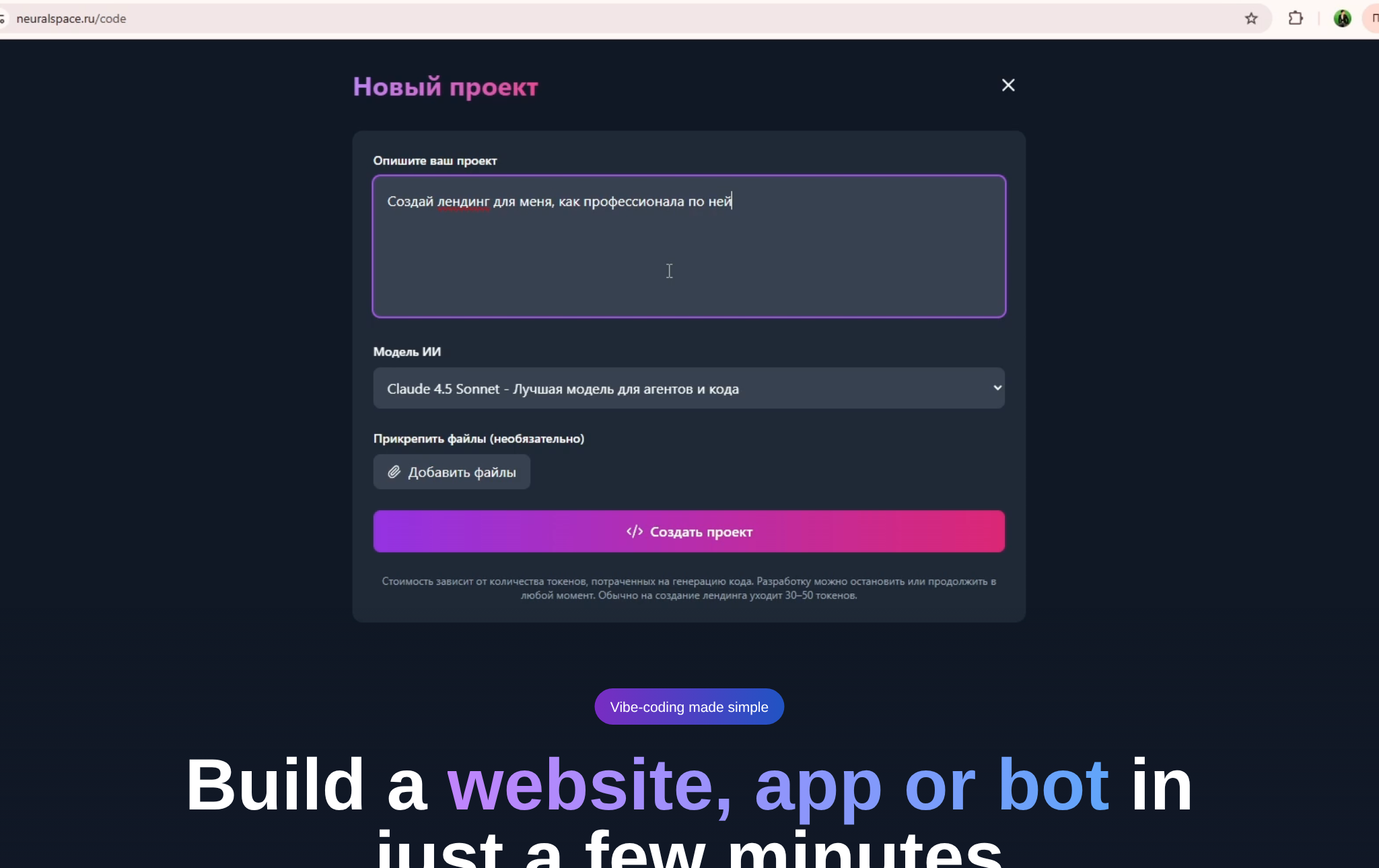
Once the site is ready you can publish it and connect your own domain — right in the same project window, with no separate hosting or server setup.
Project 2. A Telegram bot for study or reminders
The second typical scenario is a bot that asks questions, keeps a glossary or reminds you about deadlines. The brief can read: "A Telegram bot trainer for dates and terms: it sends a question, waits for an answer, shows whether it was right, and keeps a score." The key is to say where the data comes from: a list of words, dates or quotes can be attached as a file or typed straight into the task. The bot will come out working, and the agent writes the checking logic itself.
Project 3. A scraper: collect texts and data from pages
A scraper sounds like a programmer's tool, but the task is phrased in human language: "Collect the headlines and publication dates from the listed pages, put them in a table and save as CSV." That's handy for building a bibliography, following new material on a topic, or gathering prices and quotes for research. You supply a list of addresses and a clear description of what to grab; the rest is the agent's job. It hands the data back as a file that opens in a spreadsheet.
What to type and which model to choose
A useful formula: who the user is, what they see and what they can do. Instead of "make a beautiful site", write "a page for reading my translations: a list of texts, each with its own page showing the text and date, plus a search by title." Start with a cheaper model: a business-card site, a simple bot or a scraper rarely needs the strongest flagship, and your balance will last much longer. Switch to a more capable model when the project grows — several pages, complex logic, a personal account. The cost is shown before the run, so you decide with the number in front of you.
What the platform's real data shows
A quick check against the platform's own facts, so this isn't a matter of impressions. Over 90 days (July 27 – October 25, 2026), 42 vibe coding projects were created on NeuralSpace, 603 in total — from an anonymized aggregate of the production database (snapshot 2026-10-25). Over the last 30 days (September 25 – October 25, 2026) the platform ran 14,784 generations: 12,323 images, 2,001 videos and 460 music tracks — same source, counters only, with no names, prompts or user files. The numbers speak to scale, not quality: you still have to check the result yourself.
Honest limitations
Vibe coding covers websites, bots, scrapers and personal tools well. But if payments, personal data or heavy traffic are involved, a single conversation with an AI isn't enough — those projects deserve a developer's review. One more thing: the sharper your description, the fewer fixes; a vague brief yields a vague result, and that isn't the model's fault.
FAQ
Do I need to learn programming to start?
No. You describe the task in words and fix one item at a time. Knowing how a site or bot is built helps you write better briefs, but it isn't required for a first project.
How much does it cost?
There is no subscription: new users receive starter tokens, then you pay per token as you go. The cost of a specific run is shown before it starts, and a failed generation costs no tokens.
What if I don't like the result?
Don't rewrite the whole brief — fix one item at a time: "make the menu bigger", "add a reviews section". It's easier to verify and less likely to break what already works.
Can I work from my phone?
Yes, the interface is built for mobile: you can describe a project, run it and see the result from a smartphone, and open the finished site to check it there too.