GPT-6.1 Terra: a new model for chat and code

GPT-6.1 Terra is available in NeuralSpace chat, Code and the public API. This OpenAI model handles everyday work with text, code and image input. You can use it without a separate provider subscription: NeuralSpace charges site tokens for the actual request. Here is what the live interface offers and how to check the cost before a long run.
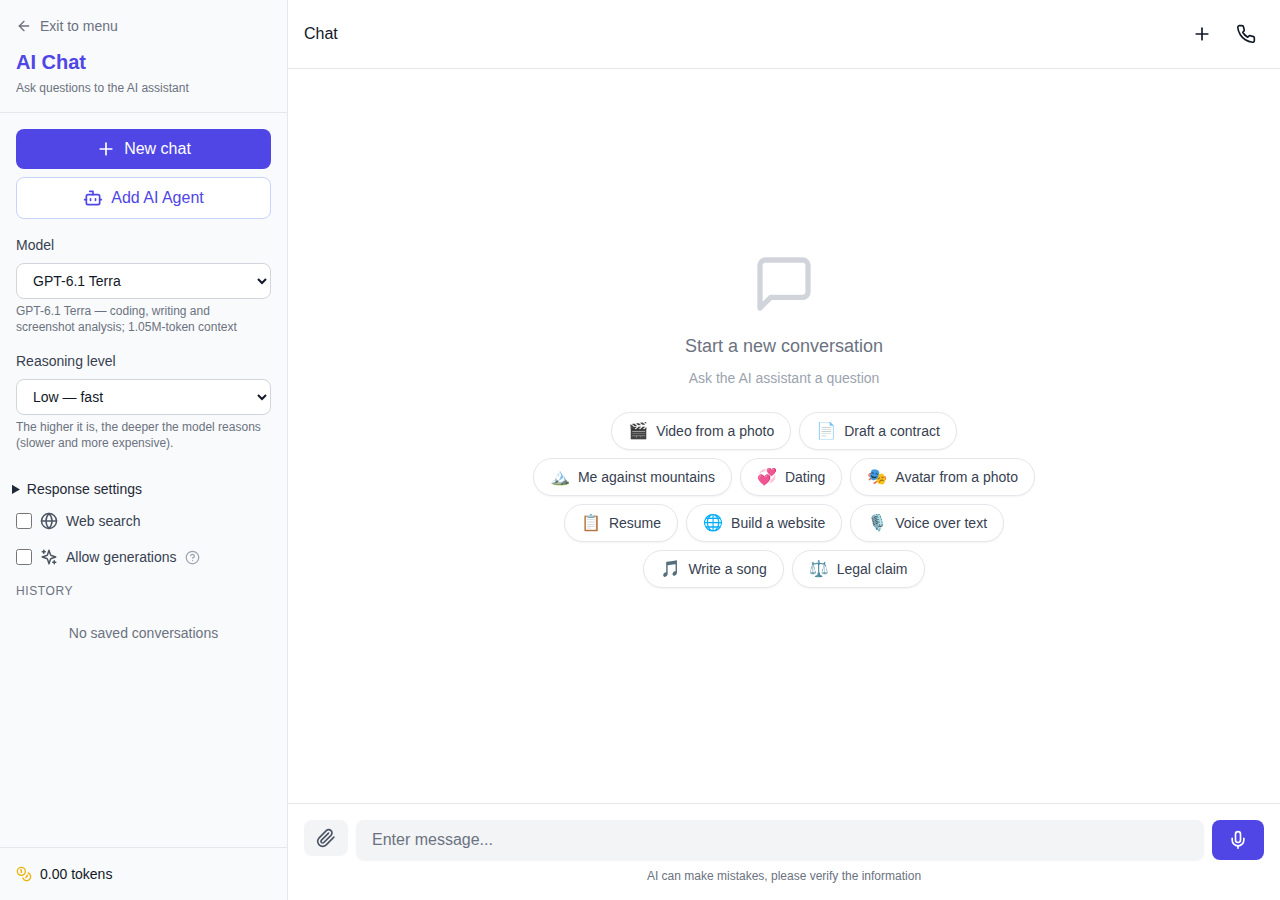
What Terra can do here
In chat, you can send text, attach an image or upload a file. The model responds in text. For example, upload a screenshot of a broken form alongside its requirements. Ask Terra to list visible mismatches and point to where it found each one. That saves a long description of the interface. You still need to check the answer: the model can misread a tiny label or miss a condition buried in a long file.
In Code, you can select Terra as the agent's model while the agent works through project files and shows its edits. Developers can also use the public API and MCP. The NeuralSpace model ID is gpt-6-1-terra; the provider ID is openai/gpt-6.1-terra. Chat has a web search switch when your question calls for current pages.
Reasoning can be switched off
Terra offers six reasoning levels: none, low, medium, high, xhigh and max. For a short email or a simple rewrite, try none or low first. If you need to reconcile conditions across a document, compare that answer with medium. Higher effort usually takes more time and may consume more output tokens. It does not guarantee a correct answer.
There is also a separate Terra Pro mode of the same underlying model. Pro keeps reasoning on for difficult tasks. Regular Terra lets you start fast and increase effort only when it helps.
Limits and pricing on 27 October 2026
Terra's context window is up to 1,050,000 tokens, and its maximum output is 128,000 tokens. The large window can hold a lengthy document, but it does not mean the model will treat every line equally well. Ask it to cite specific passages when you need to verify an answer.
At the time of this check (27 October 2026), the NeuralSpace public API price was 143.5 site tokens per 1M input tokens and 717 per 1M output tokens (287 and 1,075.5 when input exceeds 272,000 tokens). For reference, at the live exchange rate of 80.49 RUB per USD and a base top-up without bonuses (1 site token ≈ $0.0149), that is about $2.14 per 1M input tokens and $10.69 per 1M output tokens; for long context, about $4.28 and $16.03 per 1M respectively. Top-up bonuses lower the effective price. The charge for a request depends on the input and the reply; prices may change with the provider price and exchange rate. Check the current price table before a large run.
A first task you can check
Pick a short document whose conditions you already know. Ask Terra to find contradictions between two sections and quote the source passage for each finding. Try low reasoning, then medium. The difference will tell you whether extra effort improves your own task enough to justify the added time and tokens.