Claude Opus 5.5: the new flagship is live on the site

A new flagship has arrived on NeuralSpace — Claude Opus 5.5. The model is already available in the chat, the Code section and the public API. It is the next step of the flagship line: Opus 5.5 is stronger than Opus 5 exactly where long-running work and multi-step tasks matter.
What Claude Opus 5.5 can do
- Agentic coding. The model handles multi-step work confidently: it reads existing code, plans changes, applies them step by step and explains the result — noticeably stronger than earlier versions.
- Long-running projects. Opus 5.5 keeps the context of long work: large files, long conversations, multi-step instructions — the kind of load a flagship handles longer and more reliably.
- Demanding professional work. Document analysis, technical reviews, structured writing — from a simple question to a professional workload.
- Faster and more efficient than Opus 5. The same complex work takes less time and fewer tokens.
How to try it
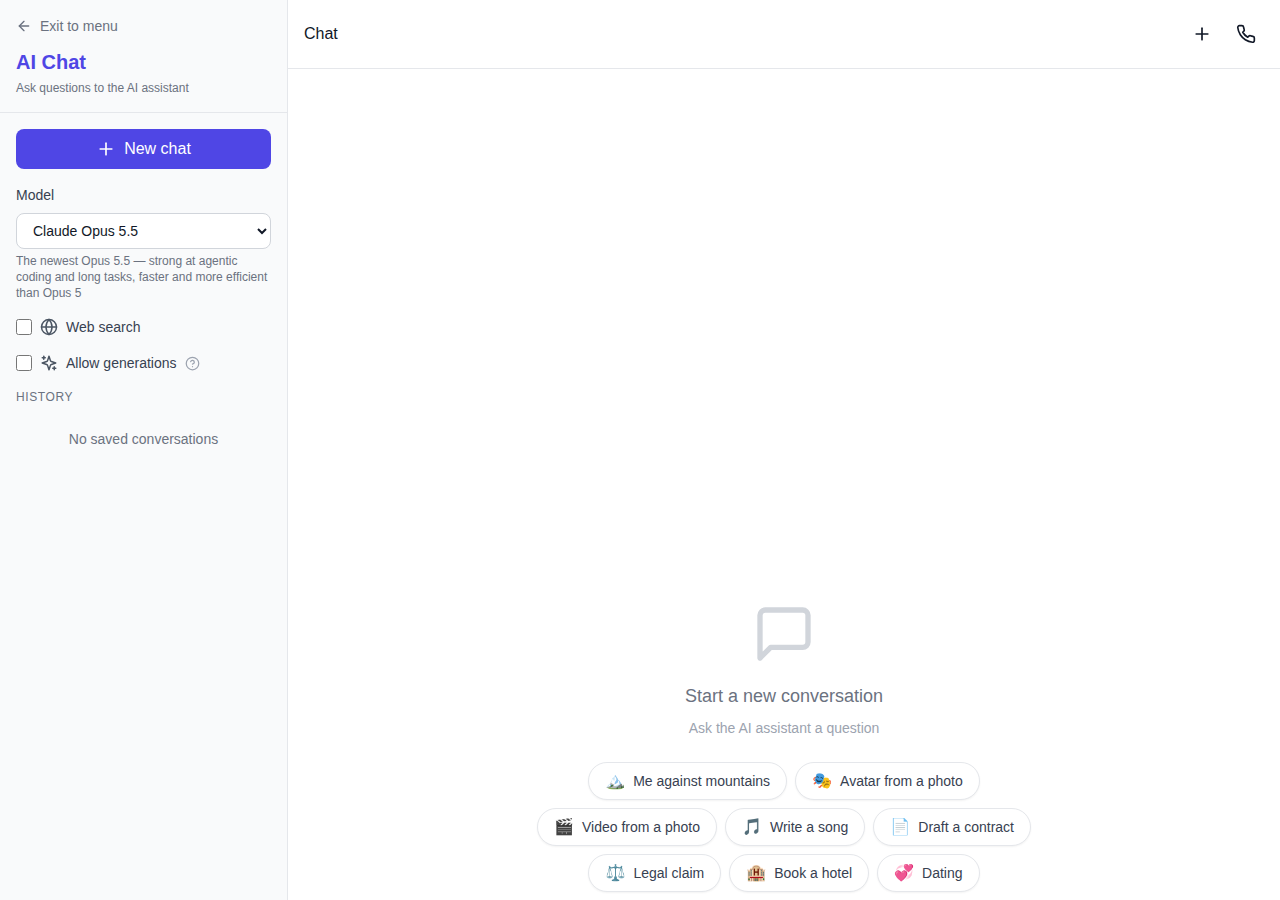
- Open the chat and pick Claude Opus 5.5 from the model list — the model page is also available at /chat/claude-opus-5-5.
- Ask as usual: the model streams its answer and supports images, documents and web search.
- For bigger projects open the Code section, where Opus 5.5 works as an agent: it creates a project, writes and edits files and runs long iterations.
Pricing is based on the tokens actually used and is charged after the answer — the minimum balance threshold is shown before you send, just like for the other models in the section.
When to choose Opus 5.5
For light everyday questions, fast models such as DeepSeek, GLM or GPT-6 Luna are enough. Pick Opus 5.5 where the task needs depth: complex refactoring, analysing a long document, a multi-step agent scenario, or an answer that must be as precise as possible. If you are unsure, start with a fast model and switch to Opus 5.5 when you hit real complexity.
Frequently asked questions
How is Opus 5.5 different from Opus 5? It is a newer generation: stronger at agentic coding and long tasks, faster and more efficient than the previous flagship.
Where is it available? In the chat, the Code section, and through the public API with a key — see the model list and prices on the API page.
Does it have web search? Yes, like the neighbouring chat models: you can ask it to look up current information.
Does it understand images and documents? Yes, the model accepts attached images and documents in the chat.