Claude Fable 5.2: model for hard reasoning and long agent runs

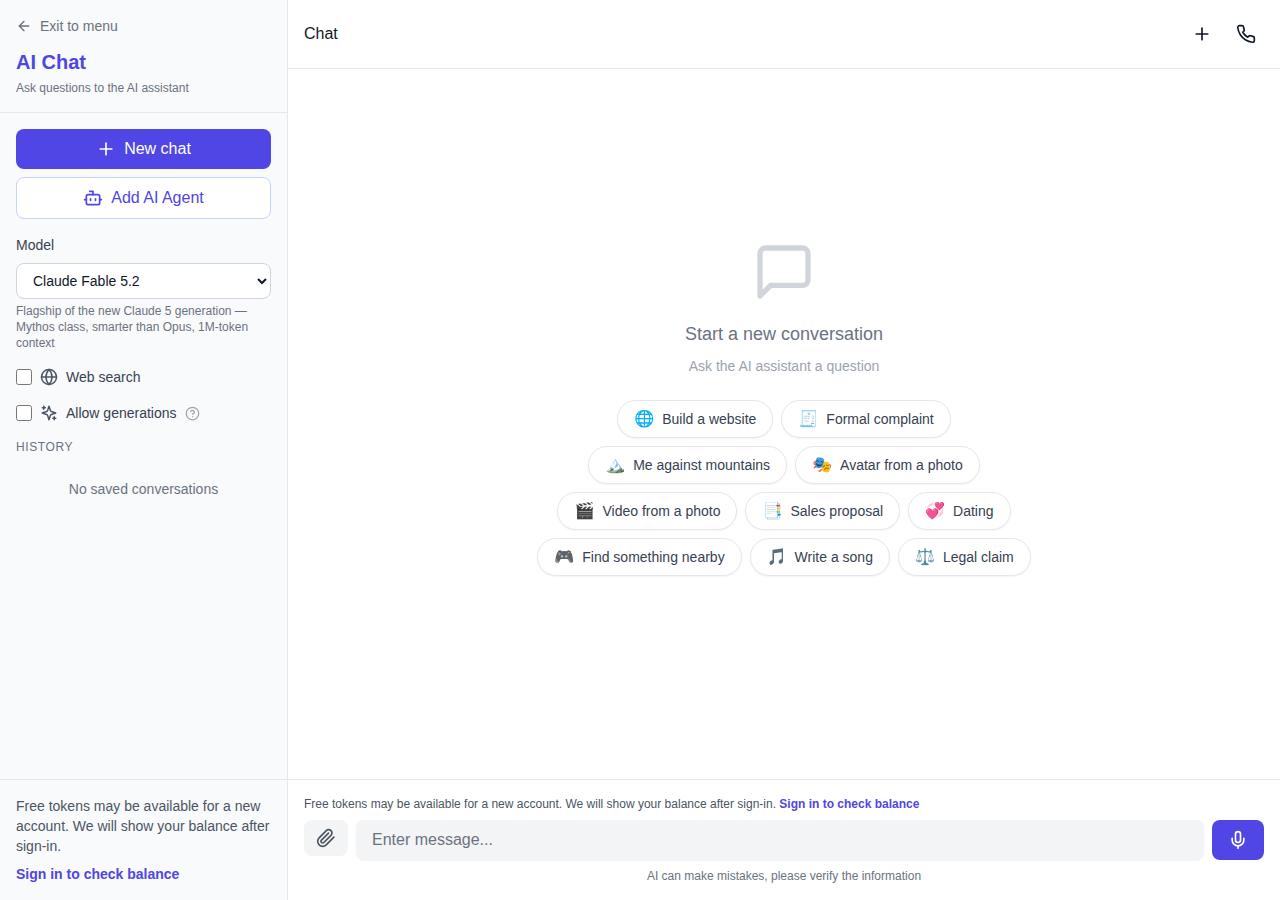
Claude Fable 5.2 — the new version of Anthropic’s Fable tier — is now available in NeuralSpace chat. The provider positions it as a model for demanding reasoning and long-horizon agentic work, where an answer has to be built from many conditions and carried through to a result. This version also costs less than its predecessor, so the choice between Fable 5.1 and 5.2 got simpler. The model is available in Code and through the public API as well.
Who version 5.2 is for
According to the provider catalog, Fable 5.2 is the senior model of the current Anthropic lineup. It sits above Opus 5.5 for work where long chains of steps matter more than speed. The guidance Anthropic itself offers is this: if Opus 5.5 at higher effort still falls short on your task, use Fable 5.2. If it does not, there is no reason to pay extra. Sonnet 5.5 and Haiku 5.5 remain sensible choices where speed and price matter most.
The practical rule follows from that: start with everyday tasks on smaller models and take Fable 5.2 for heavy work — parsing a long specification with several files, a lengthy multi-stage analysis, or an agent run where the model performs a series of steps on its own. The result still needs checking against sources; no tier exempts you from that.
What the provider catalog confirms
The model accepts text and images and answers in text. Tool use and multilingual capability are supported. The context window reaches 1,000,000 tokens with a maximum output of 128,000. Thinking in version 5.2 is adaptive and always on — it cannot be disabled; the default effort level is high. In practice that means the model spends compute on checking its own steps rather than answering straight away.
Reliable knowledge runs to June 2026. For questions that need current information, chat has a web search switch. A million-token window helps with lengthy documents, although it does not guarantee a flawless reading of every line: ask a precise question and request references to the passages the answer relies on.
How to try it in NeuralSpace
Open the model page in chat — it is preselected, so describe the task and start the conversation. For project work the model is listed in Code: the agent can inspect files, make edits and show what changed. Developers can use the model through the public API (inside the Anthropic-format endpoint too) and MCP; the identifier is claude-fable-5-2 everywhere.
Pricing: cheaper than 5.1
The provider’s official prices for version 5.2 are $8 per million input tokens and $40 per million output tokens. The previous Fable 5 and 5.1 cost $10/$50, so 5.2 offers the same capability set for less — including long answers, which are usually the expensive part. On NeuralSpace you pay per use, by the tokens actually processed, with no subscription: check the current rates on the public API pricing page before a large run — they follow the provider price and exchange rate.
A first try does not need a long input. Formulate a task with a verifiable result — for example, “find the contradictions between these two documents and point to the passage where each one arises.” Compare the answer with a smaller model on the same request: if there is no difference, a cheaper option suits this task.