Gemini 4 Argon is now live on the site

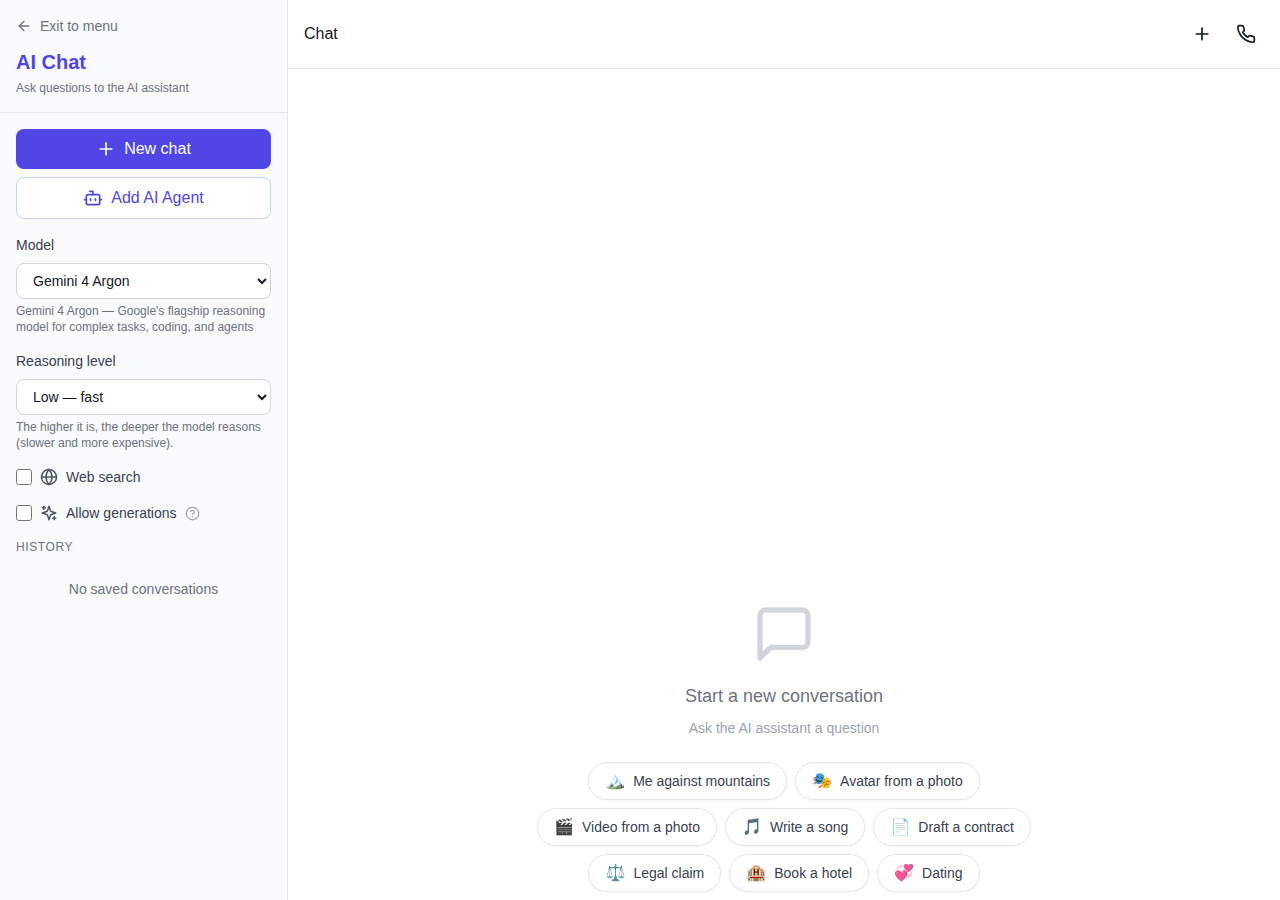
A new model has arrived on NeuralSpace — Gemini 4 Argon by Google. It is already available in the chat, the Code section and the public API. The model has its own page at /chat/gemini-4-argon.
What Gemini 4 Argon can do
- 1M token context. Upload a large document or keep a very long conversation going — the model holds the thread from start to finish.
- Not just text. Show it an image, attach a file, audio or video — the model will parse the content and answer based on it.
- Reasons before answering. Hard problems — math, logic, multi-step plans — are solved with reasoning rather than the first answer that comes up.
- Tools and web search. Like the neighboring chat models: ask it to find up-to-date information on the web.
- Coding. Reads existing code, plans changes and applies them step by step, explaining the result.
Pricing
Cost is calculated by the tokens actually used and charged after the response — the minimum balance threshold is shown before you send, just like for the other models in the section. Current prices are on the API page.
How to try it
- Open the chat and pick Gemini 4 Argon in the model list — the model has its own page at /chat/gemini-4-argon.
- Ask your question as usual: the model streams its answer and supports web search.
- For projects, open the Code section — there the model works as an agent: it creates a project, writes and edits files, and runs long iterations.
What is known: Google's numbers vs independent tests
The primary source of the figures is the official Gemini 4 Argon model card by Google DeepMind. These are the vendor's own measurements: DeepSWE v1.1 — 77.9% (agentic coding), AutomationBench — 51.3% (end-to-end business tasks), CWE-bench v1 — 68% (autonomous vulnerability closure), LVBench — 91.7% (long-video understanding), Vals Index — 68.9%. The combined input and output window is 1M tokens, while the guaranteed limit for a single response is 64K (per the OpenRouter catalog); prompt caching is 95% cheaper, and the starting price is $2 per million input / $10 per million output tokens, rising to $4/$20 after the introductory period.
Independent measurements exist too. The testing lab Vals AI ran the model on its own bench and confirmed the lead: first place out of 48 models on the Vals Index (68.9% ± 0.97) and first place out of 78 on Finance Agent v2. The cost of the check is telling: one run cost about $15.68 and took roughly 46 minutes — a heavy model, but a productive one. The review by the-decoder.com is more reserved: in its author's view, Argon closes the gap with OpenAI and Anthropic and beats rivals on individual benchmarks, but does not take a clear lead — Anthropic, by his estimate, is still ahead. That said, for a frontier model it is cheap, especially at the introductory price.
Bottom line: the numbers in Google's card are the vendor's claims; independent tests so far confirm them on the Vals Index and Finance Agent, while the other benchmarks have no third-party runs yet. A detailed breakdown of the announcement is in our separate article “Gemini 4 Argon: what we know”. On our site we only claim what actually works here: chat, Code, API, web search and tools.
When to pick Argon
Argon is a model for big jobs: long documents and conversations, parsing files and media, heavy math and multi-step agent scenarios. For quick everyday answers there are lighter models — e.g. Claude Haiku 5.5 — and for maximum reasoning depth there are the senior Claude Sonnet 5.5 and Claude Opus 5.5.