DeepSeek Harness: what an agent framework is and how to run one

A harness is the software shell around a language model that turns it from a chat partner into a task executor. The model itself only predicts text; the harness gives it tools, memory, permissions and a "think — act — check" loop, after which it starts searching the web, running code and coming back with a finished result. On NeuralSpace that harness is already running on the inexpensive DeepSeek Flash model: you can stand up an agent in a couple of minutes on the AI agent page — no software to install, no servers to configure by hand.
What a harness is, in simple words
The model is the engine, and the harness is the rest of the car: the wheel, the gearbox, the brakes and the dashboard. A bare DeepSeek Flash can read and write text; inside a harness it gets tools (a terminal, a browser, files, search, calls to outside services), memory of past steps and of you, safety rules and an action loop: the model proposes a step, the harness performs it, feeds back the result and asks "what next" — until the job is done. That is why the same DeepSeek Flash gets opposite reviews: in an ordinary chat it answers a paragraph and stops, while under a good harness it drives the task through to a file, a link or a report.
What an agent framework is made of
Every harness has the same parts:
- A system prompt — the instruction on who it is and how it behaves.
- Tools — what the agent is allowed to do: run code, open sites, read and write files.
- A step loop — the repeat of "decision → action → observation" until the task is closed.
- Memory and history — long sessions and facts about you, so it never starts from zero.
- A sandbox and permissions — the agent runs on its own server and never touches your devices.
- A schedule — recurring jobs on a timer, without you.
Why the engine is DeepSeek Flash
A harness can run on any model, but for an agent the balance of "skill plus cost" matters: one answer is not one model call but a dozen, because the agent thinks, calls a tool, reads the result and continues. On an expensive model that loop burns through your balance fast, so by default we set the cheapest one — DeepSeek Flash: it can call tools, follows instructions well and costs pennies.
How cheap, you can see in the platform's billing log: over 30 days (4 September – 4 October 2026), of 66 DeepSeek Flash calls 45 were billed, the average charge was about 0.14 tokens per call and the maximum was 0.81 tokens (source: token_transactions). A harness like that can run tasks around the clock without hurting your wallet. When a job needs maximum accuracy, the agent switches to a stronger model — at that model's own rate.
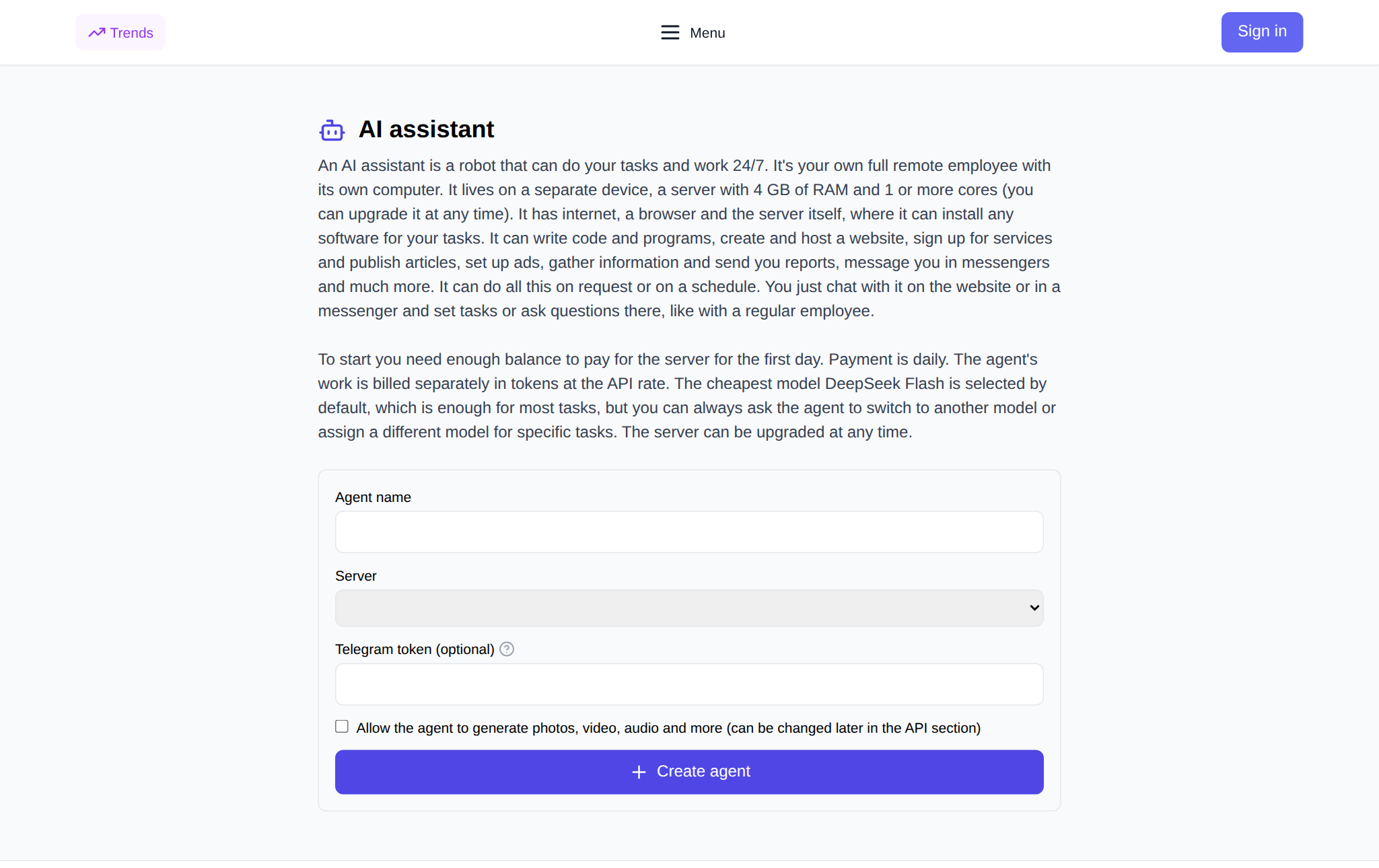
How to launch an agent on NeuralSpace
You do not have to install the harness yourself: we take care of the dedicated server and the setup. The order:
- Open the AI agent page (in chat it opens from the "Add AI Agent" button under "New chat").
- Sign in and type the agent's name.
- Pick a server — from 4 GB.
- Optionally paste a Telegram bot token from @BotFather to message the agent in a messenger.
- Use the checkbox to allow or block photo, video and audio generation.
- Click "Create agent" — installation takes a couple of minutes.
After that the agent lives in a permanent chat at /ai-agent and, if you connected it, in Telegram. You can stop it, reboot it, change the server plan or delete it along with the server, and you set tasks in plain words.
What to hand to the agent
Good first jobs for a harness are the ones that repeat and need action, not advice: collect and refresh data into a table or a report; watch a site or prices and flag changes; draft texts and publish them; file documents into folders and run backups. Many are best put on a schedule — then the agent does them itself and you just read the result in a messenger. For example: "every morning, send me a digest of news in my niche" or "once a week, check that the site is up and ping me if it is not".
What it costs
Two things are paid: the server the agent lives on (daily, from 23 tokens per day) and the model's work at the API rate — and for DeepSeek Flash that is, as shown above, pennies. New users get starter tokens and there is no subscription: you pay only for what you actually use. For a sense of scale, over the same 30 days the platform ran 12,689 generations — 9,907 images, 2,334 videos and 448 music tracks (anonymized production-database aggregates, server/seo/benchmarkData.json).
FAQ
Is a harness a separate AI model?
No. It is a shell around an ordinary language model that gives it tools, memory and an action loop. The "brain" inside is still the model — in our case, DeepSeek Flash.
How does an agent differ from ordinary chat?
Chat answers in text and stops. An agent acts: it runs commands on its own server, opens sites, works with files and returns a finished result — a file, a link or a report. And it is not tied to an open tab: it runs around the clock.
Do I need to set up the harness and server myself?
No. On NeuralSpace we handle the server and the agent installation for you: you set a name, choose a plan and, if you want, connect Telegram. No coding is required.
How much does an agent on DeepSeek Flash cost?
The server is from 23 tokens per day, and the model's work is charged at the API rate; a billed DeepSeek Flash call averages about 0.14 tokens. New users get starter tokens, and there is no subscription.