What is vibe coding? A plain-language guide and how to start

Vibe coding is a way to build software by talking to an AI: you describe in plain words what you want, and the model writes the code, runs it and shows the finished result. The term was coined by Andrej Karpathy in early 2025 and quickly became the signature word of a new wave of development: you no longer need to know syntax to program — you need to explain the task clearly. In this guide we break down what vibe coding actually is, how it differs from traditional programming, and how to try it on NeuralSpace with no subscription and nothing to install.
What it is, in simple words
Traditional development looks like this: a person writes code by hand, runs it, reads the errors, fixes them. Vibe coding flips the process: you state the outcome — "make a business-card site for a coffee shop with a menu and a booking form" — and the AI generates the files, the code and the project structure. Your role shifts from typing characters to framing the task and judging the result: keep what you like, ask for changes where you don't. The name refers to the "vibe": you set the mood and the meaning, and the model handles the technical part.
How it differs from traditional programming
A classic programmer knows the languages, tools and libraries and assembles the solution line by line. A vibe coder describes the goal and steers the AI to a working app through iterations. The entry barrier drops radically: a landing page, a calculator or a Telegram bot is now within reach of someone who has never programmed. Professional developers benefit too — vibe coding takes over the routine: boilerplate, typical pages, draft scripts that used to eat hours.
What you can build with vibe coding
Typical projects: business-card sites, landing pages, portfolios, blogs, simple web apps, Telegram bots, mini-games, dashboards and automation scripts. It shines where speed matters more than fine-grained optimization: a product prototype in an evening, a working demo for a client, a personal tool for your own task. For complex high-load systems vibe coding is not a replacement for engineering yet — but as a way to get a working product fast, it is.
How to try it on NeuralSpace
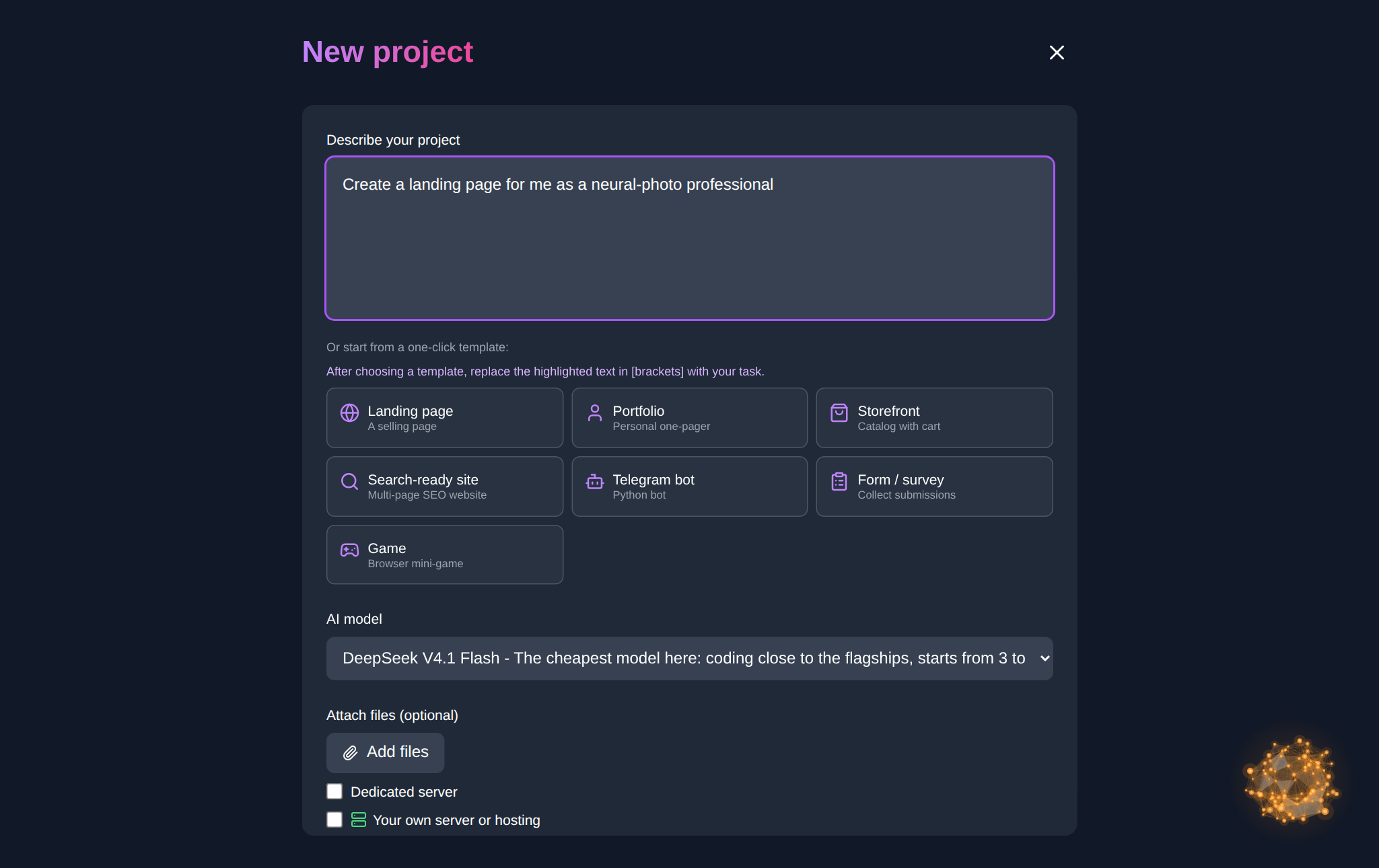
NeuralSpace has its own vibe-coding service in the Code section. The flow is simple: sign up, describe the project in plain words — for example, "a landing page for an online school with pricing and FAQ" — pick a model and run it. The agent writes the code, starts the server and publishes the site at a public link. There is no server or hosting setup and no subscription: you pay only for the tokens you spend, and starter tokens are credited right away for new users.
Which model to pick
Top models are available under the hood: Claude, ChatGPT, DeepSeek and others. A practical rule: start with DeepSeek — it is tens of times cheaper than Claude and not much worse for most typical tasks, so your balance lasts noticeably longer. When a project is complex and you need maximum precision in code, switch to Claude or ChatGPT. Switching models takes one click in the same interface.
FAQ
Is vibe coding the same as no-code?
No. No-code assembles apps from ready-made blocks, and you are limited by the platform. Vibe coding generates real code for your task, so the limits are set by what you can describe.
Do I need to know how to program?
For basic projects — no. You need to describe what you want clearly. Understanding how web apps are structured helps you write better prompts, but it is not required.
How much does it cost?
On NeuralSpace there is no subscription: you pay only for the tokens spent on generation. The price depends on the model and is shown before you run it; new users get starter tokens for their first runs.
Where can I try vibe coding for free?
In the Code section on NeuralSpace: sign up, describe your idea and run it — starter tokens for first runs are credited after sign-up, after that you pay per token with no subscription.