AI agent vs chatbot: what it can do and how to make one

An AI agent is a program that uses a language model as its brain but, unlike an ordinary chatbot, does not stop at an answer: it breaks a task into steps, uses tools — search, a browser, a terminal, files — and comes back with a finished result. In plain words: a chatbot tells you how to build a price table, an agent builds it. Below: how an agent differs from a chatbot, what it can really do, and how to stand up your own agent on NeuralSpace with per-day billing.
An AI agent in plain words
The word «agent» comes from classic programming: it means a program that acts for you, on request or on a schedule. In the era of large language models the agent got a brain that can reason and use tools. Here is how it works: the model proposes the next step, the harness performs it, the result goes back to the model — and so on until the job is closed. So an agent is better pictured not as a smart chat but as an employee with their own computer: a workplace, internet access and memory of what you have discussed.
It helps to separate three levels. Level one is an ordinary model that answers in text: advice, no action. Level two is an assistant with tools: it performs a single action on request — opens a site, calculates, generates an image. Level three is an autonomous agent that carries the whole task itself, from the first step to a finished file, report or publication, and returns to recurring jobs on a schedule.
How an agent differs from a chatbot
A chatbot runs on a question-answer loop: it writes text well but does nothing outside the dialogue. An agent adds action and time.
- The result. A chatbot returns text. An agent returns a file, a link, an email, a table or a report.
- Actions. A chatbot advises how to do something. An agent opens sites, runs code, installs software and works with documents itself.
- Time. A chatbot lives while the tab is open. An agent runs on its own server: it can work while you sleep and wake up on a schedule.
- Memory. Chat keeps the messages of one session. An agent keeps long-term memory of you, your tasks and previous steps.
- Mistakes. A chatbot errs in words, an agent can err in deeds. So check the result — especially before publishing, sending or paying.
What an agent can really do — and what not to expect
An agent's abilities are the tools of its harness: search and a browser, a terminal and code, files and messengers, a scheduler. In practice you can hand it: gathering information and turning it into a table or a report; writing and running a program; drafting and publishing a text; producing images, videos or voiceovers on request; watching prices or news; doing recurring jobs on a schedule.
What not to expect: an agent does not replace a specialist and does not guarantee flawless work; it solves a hard task step by step and sometimes errs; one agent reply is not one model call but a whole chain, which is why a cheap engine saves noticeably. And about time: generation is not instant. Here are honest numbers from anonymized platform aggregates over 30 days (September 4 — October 4, 2026): 9,458 successful image generations; the most popular model, Nano Banana 2, ran 2,249 times, and the median time from launch to a finished frame for SeeDream 5 Pro was 86 seconds (1,241 generations). An agent does not mind the wait: it can pause and continue from the same place.
How to launch your own agent on NeuralSpace
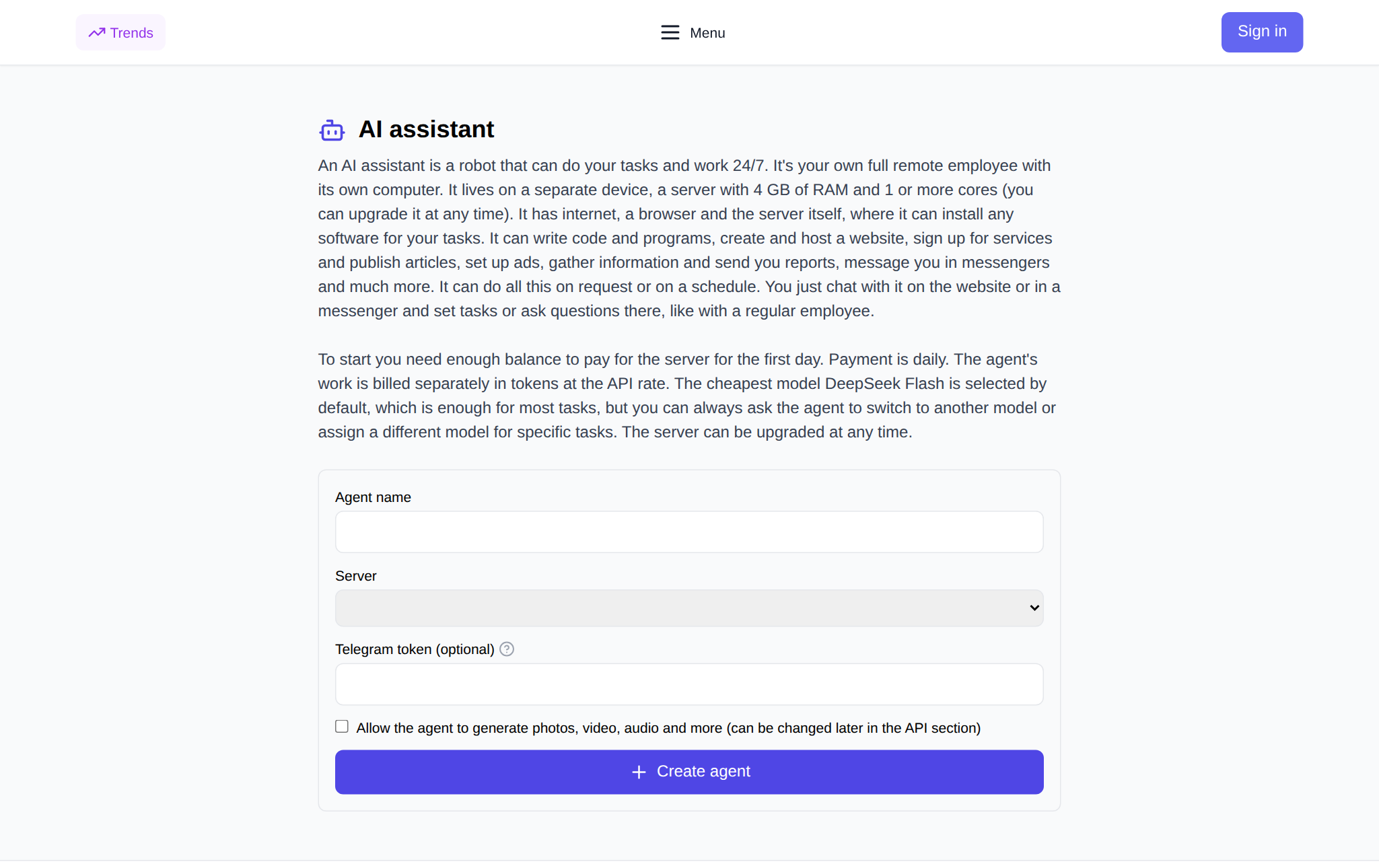
You do not buy a server separately or configure it by hand — the agent is created right in the interface:
- Open the AI agent page — the same page opens from the «Add AI agent» button under «New chat».
- Sign in and give the agent a name.
- Choose a server — at least 4 GB of RAM; you can upgrade at any time.
- Optionally paste a Telegram bot token from @BotFather — then the agent can reply in a messenger.
- Use the checkbox to allow or deny image, video and audio generation.
- Click «Create agent» and wait for the install — usually a few minutes.
Billing is per day: your balance needs the first day's amount, then the price is charged once a day, with no subscription. The agent's own work is billed separately in tokens, as with the API. The default engine is the most affordable model, DeepSeek Flash: it is enough for most tasks, and the agent can switch to a stronger one on request. For reference on models: in chat over the same month the most frequent replies came from GPT-5.6 Terra (120 of 619 answers) and GPT-5.4 Mini (119) — anonymized production-database aggregates. Files you exchange with the agent travel through its own server and are not kept on our side.
What to hand to an agent first
The best start is routine that repeats and needs action, not advice:
- gathering information: prices, news, updates — into a table or a report;
- code work: write a script, fix a bug, deploy a simple site — handy to combine with the Code section;
- texts and publications: an article draft, posts, letters;
- model-made content: images, videos, voiceovers — for example via image generation;
- recurring jobs on a schedule: a morning digest, price checks, backups;
- links to outside services: the agent connects over MCP, and our server is described on the API page.
Give the first task simple and verifiable: for example, «gather the specs of three models from our site into a table». That way you see how the agent reasons and acts, and where it needs a hint.
FAQ
Is an AI agent a separate model?
No. An agent is a harness around an ordinary language model: it gives the model tools, memory and an action loop. The brain inside is still a model — by default DeepSeek Flash, and you can ask the agent to switch.
How is an AI agent different from a chatbot?
A chatbot answers in text and stops. An agent carries a task through steps: it searches, works with files, runs code and brings back a finished result; it lives on its own server and can do recurring jobs on a schedule.
How much does an agent cost?
Billing is per day: the price depends on server power (4 GB minimum), and the exact amount is shown before you create it. The agent's work is billed separately in tokens, as with the API; new users get starting tokens, and no subscription is needed.
What should I hand to an agent first?
Something simple and verifiable: gather data into a table, draft a text, make a digest, tidy up files. A good first task is one where you can easily tell a correct result from a wrong one.