DeepSeek V4 Pro 0813 is a historical turning point

Briefly about the main thing (BLUF)
DeepSeek released the final version V4 Pro - revision 0813: the update arrived automatically via the API, without presentations or references. We look at what exactly has increased using benchmarks, honestly calculate the difference with Claude and GPT and explain why the price has not changed yet.
Today DeepSeek rolled out the final version V4 Pro - revision 0813. No conferences or countdown counters: just updated the API. Those who have already worked with `deepseek-v4-pro` automatically received a new model without changing anything in the code. The April one was a preview, this one is GA, and the difference is noticeable primarily where the model is expected not to respond in a chat, but to work coherently.

Today is the day when Opus-level coding became truly accessible. This proposal would have been a marketer’s dream in the morning, and in the evening it would have been a fact with benchmarks to boot.
In NeuralSpace the model is already standing: in chat, V "Code" section and in API. There’s no “waiting for it to roll out”—you open it and use it.
What model
Technically, this is the same beast as in April: Mixture-of-Experts with 1.6 trillion parameters, of which 49 billion are active at each step. The context is a million tokens, and the model is capable of producing up to 384 thousand tokens in one response. For comparison: this is about twenty times more than most models in the neighboring tabs.
The model can think in two modes - thinking and non-thinking, and reasoning_effort now has three levels: max, high, low. In practice, this means that a small issue can be solved cheaply, and a complex chain can be resolved with maximum thought, without changing the model.
Benchmarks: what exactly has grown

Artificial Analysis re-measured the final version. Intelligence Index increased from 43.7 to 45.3. Coding Index - from 58.7 to 59.4. But the Agentic Index jumped the most: from 35.3 to 37.8. This is not an accident - revision 0813 was corrected specifically for agent-based scenarios, where the model does not respond in one sitting, but goes back and forth: reads files, calls tools, looks at the result and corrects itself.
In terms of speed, everything is at the level of the previous version: about 76 tokens per second at the output, the first token arrives in about one and a half to two seconds. That's fast for a model of this size. Honest downside: the model is talkative. At AA measurements, it splashes out one and a half to two times more tokens than the market average - consider that for detailed reasoning you are paying with both extra tokens and extra seconds of waiting.
Against Claude and GPT: fair arithmetic
The most noticeable thing in the latest table is the line with Claude Opus 4.8, Anthropic’s former flagship. DeepSeek V4 Pro 0813 beat it in coding benchmarks on both sides: Terminal-Bench 2.1 - 87.9 versus 85.0, DeepSWE - 62.7 versus 58.0. At the same time, Opus 4.8 costs $5 per million input tokens and $25 per million output tokens - 11 and 29 times more expensive. Here is the table:
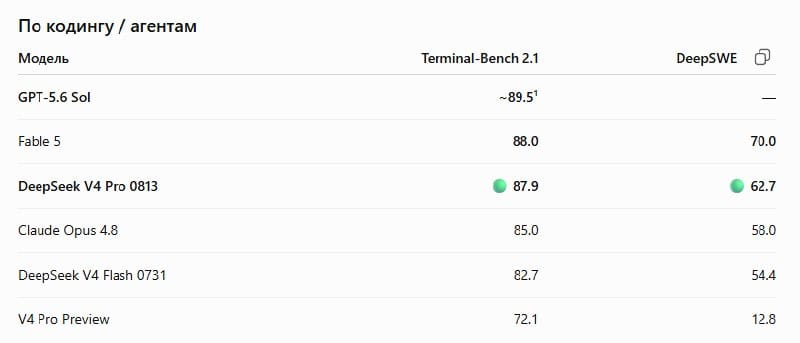
The final version came closest to Claude Fable 5: 87.9 versus 88.0 in Terminal-Bench—a one-tenth difference. According to DeepSWE, Fable is more noticeably ahead: 70.0 versus 62.7. If you count all ten agent-based benchmarks from the table DeepSeek, Fable is ahead by an average of 5.3% - but on two out of ten DeepSeek wins, and without the only outlier (Humanity's Last Exam without tools: 42.7 vs 53.3) the average lead shrinks to 2.8%.
The price differs not by percentage, but by several times. Fable 5 costs $10 per million input and $50 per million output tokens; V4 Pro has $0.435 and $0.87. At the mixed rate it works out to about $30 versus $0.65. That is, for a difference of a few percent in tests, Anthropic asks to pay approximately 46 times more. Honesty caveats: I measured the comparison table DeepSeek myself, on my own unpublished infrastructure, two out of ten tests are internal, and there are no independent measurements of 0813 yet - the model was released only today.
To understand the scale, think about the Kimi K3. A month ago, she was the first Chinese model to overtake Claude Opus - it was a sensation. But Kimi K3 is a model with trillions of parameters, it requires an expensive server to run, so at retail it is only three times cheaper than Claude Fable and only 40% cheaper than Claude Opus. Impressive, but there is no democratization in this.
But DeepSeek V4 Pro is a truly historical moment. Really catching up with Opus in terms of coding, it costs 30 times less than Opus and 60 times less than Fable. Today, vibecoding has become accessible to everyone—not in the advertising sense of “available,” but at the price of entry into it.
With GPT the situation is more complicated. GPT-5.5 scores 56.3 in the Artificial Analysis index versus 45.3 for DeepSeek - the gap is honestly noticeable. But the tariffs are not comparable: $5/$30 per million versus $0.435/$0.87. But the cheaper GPT-5.6 Luna already costs $0.10/$0.60 - that is, cheaper than DeepSeek - and scores 52.3. It turns out that the “cheapest of the big” is no longer the only one: at a price of V4 Pro it competes with Luna, and in terms of points it loses to both Terra and Sol.
I’ll add a sober quote from the outside: a recent assessment of the American NIST (CAISI) said that V4 Pro lags behind market leaders by about eight months. True, they measured a preview version. Whether 0813 has narrowed this gap will be shown by independent benchmarks, but they don’t exist yet.
The price has not changed. Bye
Entry – $0.435 per million tokens, exit – $0.87. Cash hit is still almost free: $0.003625 per million, 120 times cheaper than regular entry. For agent chains, this is the main point: the project context is read again and again, and it is the cache that decides how much an hour of agent work costs.
One caveat: DeepSeek has already warned in the documentation that it is going to raise prices for its API as a whole. When and for how long is not said. The April tariffs are still in effect, and this is noticeably lower than Western analogues of a comparable class.
Where to try it right now
- Chat: open model page — the final 0813 is already the default.
- Code: V "Code" section the model connects to the project and works with the repository, files and terminal.
- API: the key is issued in the section API keys NeuralSpace, format compatible with OpenAI.
Payment - in rubles from the general balance, without subscription, VPN or foreign card. Actual usage is written off, not the “month in advance” package.
What the model can’t do is look at pictures: the input is text only. If you need analysis of a screenshot or photo, this is for other models. But for text, code and long agent tasks, the final V4 Pro is now one of the most honest proposals in terms of power and price ratio. You can check it in chat, and if you need to build it into your product - the key is taken from the API keys page.
Frequently asked questions (FAQ)
Question: How to get started? Answer: Register on the platform and receive free tokens for testing.
Question: Are the generated materials suitable for commercial use? Answer: Yes, you receive full commercial rights to all content created.